One cooking robot can repeat a measured task with steady motion. Making a dish that tastes right after the ingredients change is a much harder job, because cooking depends on smell, texture, timing, and judgment.
- Repeatable motions suit robots
- Taste and texture remain hard to measure
- Human chefs still set the standard
What a cooking robot can do
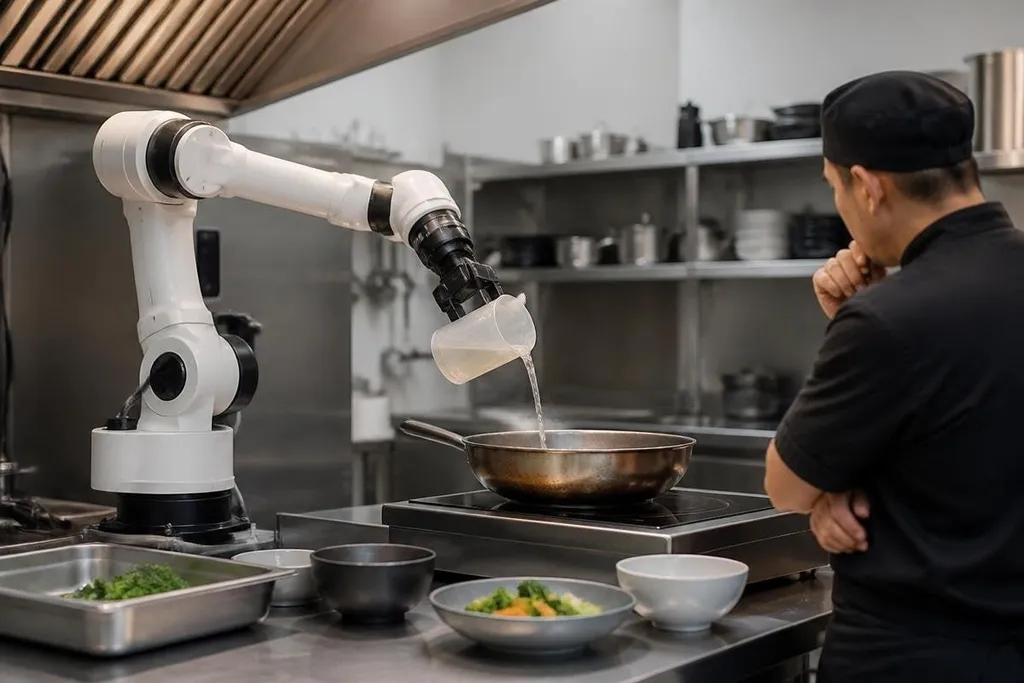
A cooking robot would work best when the kitchen gives it fixed tools, fixed ingredients, and a clear recipe. Its arm could move a pan, pour a measured amount, stir at a set speed, or place food on a plate.
That kind of task suits software. The system receives a target, checks its position with cameras or force sensors, and repeats the motion. Force sensors measure contact, so the arm can tell the difference between touching a bowl and pushing hard against it.
The recipe must also describe more than the ingredient list. It needs cooking temperature, stirring speed, pan position, wait times, and the point at which the food is ready. A human chef fills in many of those details by sight, smell, sound, and touch.
Why taste is the hard part
A recipe can say “cook until done,” but that instruction leaves a large gap. A tomato may hold more water than expected. A sauce may thicken sooner. A piece of meat may need more time because its shape differs from the last one.
Temperature and weight are easy for an automated system to read. It may also inspect color with a camera. Those signals help, but they don't fully describe taste, aroma, or mouthfeel, and the right result can depend on the person eating the meal.
This is where the word “chef” matters. A chef chooses how to adjust a dish after noticing a change. They may add salt, lower the heat, change the cooking time, or discard a batch. Those choices have to be written into a robot's control system, along with enough sensor data to know when each choice fits.
The kitchen itself adds another problem. Steam can cloud cameras. Grease can cover surfaces. A loose towel, a wet handle, or a crowded work area can change the robot's path.
Food safety adds checks for temperature, cleaning, and contact between raw and cooked ingredients.
The business case comes before the title
A kitchen operator would first ask what task the robot can repeat and what labor that task removes. One machine that cooks one sauce for a fixed menu may fit a factory or a high-volume restaurant. A system expected to handle a changing menu needs more sensors, more software, and more time for setup.
The price question matters too. The robot needs an arm, cooking equipment, sensors, cleaning steps, and service. If staff still have to prepare every ingredient, correct mistakes, and wash the robot, the machine may save less work than its sales pitch suggests.
The next useful check is whether a cooking robot removes kitchen work or moves it to a person. For that check, Robot24.com reports on robotics companies and machines, so you can compare the robot’s task with the staff time and service it still needs.
I'd skip the phrase “master chef” for now. One robot may become very good at one menu, but that is a narrower claim than cooking well across new ingredients, new kitchens, and changing customer tastes.
A practical buying checklist
Before treating a cooking robot as a chef, check these points:
- Name the menu: list the dishes the system must make without human changes.
- Test ingredient changes: vary size, moisture, shape, and starting temperature.
- Measure the handoffs: record how much staff preparation and cleanup remain.
- Check food safety: confirm temperature records, cleaning steps, and raw-food controls.
- Price the whole system: include service, kitchen changes, software, and downtime.
- Set a failure rule: decide when a worker takes over and how the robot stops.
That checklist points to a useful boundary. Robots can become reliable cooking machines when the work stays controlled and repeatable. Becoming a master chef requires judgment that still has to be measured, taught, and tested in a real kitchen.